Returning To Center: A Family Trip to China


A family pilgrimage through China for my Qi Gong Teacher Shifu Wang’s 89th birthday
This spring my family and I went to China. We went so that I could travel with my qigong teacher, Heiner, to visit our teacher, Master Wang Qingyu, whom we call Shifu Wang, for his eighty-ninth birthday. That was the heart of it, the initial reason for the trip. That, and getting to bring my family fully into my world. Chinese Medicine is everything to me, but it’s difficult to talk about. This would be my whole family, especially my partner, experientially into this beautiful ontology that has changed every cell of my being over these past 12 years. And we were not disappointed.
We travelled to eight places across three weeks, along with a dozen other members of my community, and two threads ran through every single stop that I keep coming back to. First, transmission. The way the deepest things in this medicine and in this life move from one person to another. Transmission goes beyond lecturing, beyond teaching. Transmission is what happens when you are able to drop in to the felt sense, the energetic field if you will, cast by someone who is so deeply steeped in their practice. It is clear, potent, in a way that is indescribable in words. The second thread is the return to center. This is the very meaning of our medicine, and which I found waiting for me everywhere I looked, in the grandest teachings and in the smallest, most ordinary moments of being with the people I love.
Chinese medicine, in Mandarin Chinese, is 中医 (zhōngyī), the Medicine of the Center. The medicine of returning to center. The medicine of Heart. Of the present moment. And once I started seeing the trip through that lens I could not stop, because I began to realize that the center and the transmission are not separate at all. Depth in anything, in a medicine, in a practice, in a person, comes from being present with it, returning to it over and over, until presence becomes the very thing that gets transmitted. And so transmission is itself a kind of returning to center. There is nothing like being in the presence of someone who has actually lived the thing they are teaching. Anybody can say the words. But when the person saying them is the person who has lived them, there is a depth that simply cannot be distilled onto a page, into a podcast, into a conversation. We met person after person like that. I am still feeling it reverberate through all of us.
And I should say here, because it was true of every single day of the trip, that every morning we got up and practiced qigong together. Jack would stay in bed with the girls while I went off to practice with my teacher and my community, and we did the fourteen movements, the same form I am now teaching in my continuing qigong class. That daily practice was a return to center I did not fully understand the value of until I came home and lost it, and felt its absence immediately, in my body.

We flew into Beijing, just me, Jack, our freshly one-year-old, Sky, and our almost-four-year-old, River, and from the moment we landed we were moving. Straight to the train station, where we met up with our group and took a train a couple of hours west to a city called Datong. Datong sits on what was historically the northern border of China, though now of course it is fully China, and from the train we could catch glimpses of the Great Wall out the windows. This was a city captured back and forth between China and the Mongols for centuries, and you can still feel that history in it.
Datong: the hospital and the primary water

In Datong we stayed somewhere I still have trouble describing without sounding like I am exaggerating. It was a Chinese medicine hospital, still being built, on a hill, with a luxury hotel with two hundred rooms. The first two floors were the clinic. The whole thing is the project of an ultra-wealthy man who already owns three western hospitals and wanted to build something different, a facility that was pure, true, classical Chinese medicine. He is friends with Liu Li Hong, who is extremely famous in China and is the country’s elected expert on the Shang Han Lun approach to herbalism, and you could feel that this place was being built in earnest, as an act of devotion to the medicine rather than as a business.
When he opened the property, he found something he was not looking for. A mile beneath the ground was primary water, water that has been boiling, untapped, for thousands of years. It is so hyper-saturated with minerals, volatilized and dissolved over all that time, that no matter how long you boil it you never get any mineral deposits left on the kettle, even though the mineral content is thousands of times higher than the water you would buy in a store. We got to drink it by the gallon and bathe in it. There was something fitting about beginning a pilgrimage about returning to center by drinking water drawn from the deep center of the earth, water that had been quietly concentrating itself for millennia, waiting. In the basement there was a spa built around it, and on the grounds he was building traditional Chinese courtyard villas, private suites each with their own indoor and outdoor soaking pools of that rich mineral water. In his own private villa he kept a library of first-edition original writings of some of the classic texts, five and seven hundred years old, and a fantastic tea room.

Our first day there we went to a UNESCO World Heritage site nearby, where elaborate Buddhas are carved into a series of caves. They are fifteen hundred years old, commissioned by the government, richly colored, and still astonishingly preserved. I was so proud of River for all the walking she did, and she was so taken with the Buddha statues that she just wanted us to tell her stories about him, which we did for several bus rides afterward. These are the moments I have come to recognize as my own returns to center: when I stop, and watch my daughter meet something ancient and holy with nothing but open wonder, and feel myself drop straight back into what matters.
Pingyao: the walled city and the princesses

From Datong we boarded another train and headed south to the ancient walled city of Pingyao. Pingyao is the only city left where the original exterior wall, the defensible city wall, is still completely intact, and inside it the ancient city is fully intact too. It is a beloved destination for Chinese travelers, and we had a wonderful time there. We stayed in an old traditional building arranged around a courtyard, which turned out to be so sweet, because it brought our whole group together. We were all accessible to one another in that shared space, drifting in and out of each other’s rooms.
This was the one stretch of the trip where no one was hosting us, which made it our most relaxed time. No plans, nowhere we had to be, we just got to explore and wander the ancient streets. And so much of my joy on this trip, so much of my returning to center, returning to the Heart, came from watching River in moments exactly like these, running room to room to see all of her new friends, dressing up with them, hanging out with them, being so independent at almost four years old. Freed from the obligations of home, I had a capacity to be present and connect with her, to really see her, in new and intimate ways.

All up and down the streets of Pingyao were shops where you could pay to be dressed and have your hair and makeup done in traditional Han Chinese fashion. So everywhere you looked there were beautiful women in beautiful traditional clothes, and River decided that they were all princesses. She would get so excited and yell “princess! princess!” and go chasing after them to bombard them with hugs. These unexpected princesses would be confused at first, not quite understanding what was happening, and then they would see this sweet little American girl, and their faces would just light up with delight as they dropped down to her level and swooped her up to take pictures. Shifu had asked that everyone come to his birthday in traditional clothes, so we all went on a little shopping trip in Pingyao to find ours. River got her very own princess dress there, a traditional Chinese dress, for the banquet to come.
Mount Jue: stairs, temples, and tea with Jessica
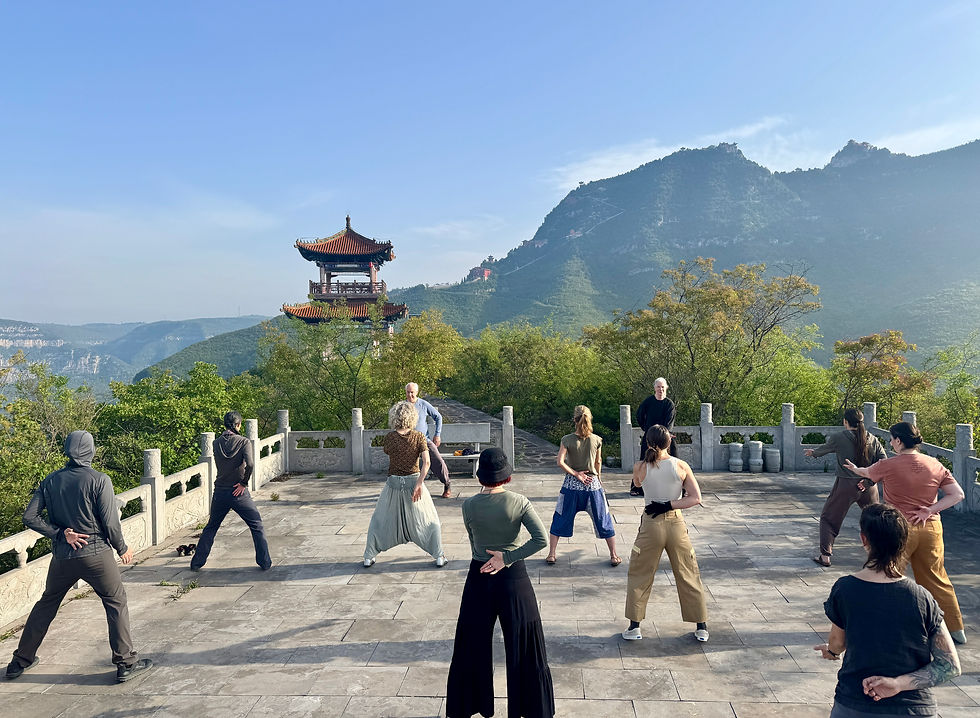
Next we got on a bus and headed south again to a completely different landscape, to visit a woman whose western name is Jessica. She is Chinese, but she lived for several years in Germany, and Jessica is the name she goes by. She is building a retreat center on the mountain, still under construction, so we stayed in a hotel nearby. Driving in, we passed exactly the scene you picture when you imagine the wilderness and mountains of China: a river-carved mountainside, exposed peaks, jagged and rugged, still low in elevation but rugged in a way that drops you immediately into wonder.
What usually happens on these trips is that you drive into a place like this, you see the big mountains with beautiful old temples on top of them, and you turn to each other half-joking and say, I wonder if we are going to climb up there. And so, of course, after we reached the hotel and unloaded our things, the first thing we did was climb that huge mountain to visit the three temples on top of it. This is already a big experience without children, because in China the way up a mountain is not gentle switchbacks. It is stairs. Endless stairs, up impossibly steep mountainsides, and the steeper the slope the taller the stairs become, all of them uneven, matching the grade of the mountain. You climb for a couple of hours, essentially. And we were doing it with a one-year-old and an almost-four-year-old.

Let me tell you, River was a trooper. Her dad carried her up some of the steeper stretches, but she was so motivated by being with all of her new adult friends, everyone cheering her on, that she walked most of it herself. I carried Sky in the carrier and we just kept climbing and climbing. Some of those climbs were terrifying, so steep going up that you were almost on all fours while still standing, and so steep coming down that you went on all fours out of plain fear. And then you reach the top, and there are these beautiful old temples and a vista out over the river, and it is worth every single step.


The Nei Jing, the classic of Chinese Medicine describes the different channels and acupuncture points resonate with specific locations in China. One day the rest of the group took a trip to follow the river associated with the Heart Channel all the way to its source, the physical place on earth of Heart 1, the acupuncture point Utmost Source. I was sad to miss it, but it was good to have a rest day with my family after the climb, relaxing in a park, letting River and Jack play, letting all of us recover. A whole day of nothing but my family in a park turned out to be its own return to center, no less than following a river to the source of the Heart channel. That evening we had tea with Jessica and learned more about who she is and what she does.
Jessica teaches neigong, inner cultivation, which she has been learning from a teacher who first came to her in her dreams. She keeps a dream practice, tracking her dreams, learning how dreams talk and how they communicate. In Chinese medicine this carries real weight, because the Hun, the spirit associated with the liver, goes off at night and reconnects with something larger, and can bring things back to you. It is said that the Shen follows the Hun: your Spirit follows the Hun, so that when you build a strong relationship with the Hun and strengthen it, you are strengthening your whole body, spirit, consciousness, and awareness along with it.
I think that is exactly what has happened with Jessica. The more dream work she has done, the more permeable she has become, more aware of the different layers of reality, able to see some amount into the future and quite strongly into the past. She is, in her own way, a living example of returning to center, of a person so settled into the still point of herself that the noise has dropped away. As you spend time with her, she simply receives information about your spirit, about you in this life and in past lives.
She shared things with me and with one of the others in our group that were powerful and exact, and the experience of sitting with her was one of those rare moments when reality just becomes crystal clear. There was no noise. It was like the end of a long meditation retreat, when everything is so sharp and so strange and so quietly powerful. That was a real gift, and it was the close of our time in northern China. It was also transmission of the purest kind, the kind that passes between two people in a room and could never survive the trip onto a page.
Chengdu: the familiar city

From there we took a bus and a train and a plane down to Sichuan province, the part of China most familiar to me, this being my third time there. We landed in Chengdu and stayed in the same hotel we stay in every time, which has become so dear to me. I know the neighborhood now. I know my way around. There is a particular sweetness in returning to a place enough times that it starts to know you back, which is its own small lesson in what it means to return.
While we were there I got a traditional tui na massage that completely blew my mind, honestly one of the most impactful things of the whole trip. The practitioner was so focused, and the work was so intense, exquisitely painful, all of it concentrated on the acupuncture points and the channels. It cleared so much stagnation out of my pelvis and shoulders that two and three weeks later my range of motion is still dramatically improved, which is, when you think about it, simply the body being returned to its own center.
I also reached out to a friend I have made in China who sells tea, and we went to his tea market and sat and drank tea together for the third time now. I first met him back in 2019, and in the years since we have both had children, both grown and changed. There is something tender about never knowing whether I will see him again, and then seeing him again, the next time we are in Chengdu. Another return.
Mount Qingcheng: Shifu’s Birthday, and what Liu Li Hong shared

From Chengdu we went up to Mount Qingcheng, a Daoist mountain nearby. This is the mountain where Master Li Dao, the Monk with the ubiquitous smile and teacher of my teacher Master Wang Qingyu, spent most of his time practicing, and where Master Wang now lives in his retirement. We stayed in a Buddhist monastery there, Puzhao Temple, my third time staying in it, and I feel a deep connection to that place.
The second day there was the birthday banquet. It was a large gathering, full of so many of Shifu’s disciples, all of us there to honor him. There were performances, including Chinese disciples performing aspects of the qigong forms that I know and love and treasure so dearly, and it was beautiful to witness the way they do them. But the thing that really moved me, as it always does, was watching the heart connection between my teacher Heiner and Master Wang. It brings me into a depth of feeling I rarely touch anywhere else. This is transmission made visible, and because in our medicine the heart is the center, watching it was its own return to the center of things.

River was in the pink princess gown she had been asking to wear every single day, a floor-length traditional ball gown, and she finally got her moment in it. Managing two small children through a banquet several hours long was a lot, it was a real challenge, and it was deeply rewarding, and we were so happy to be there. Both of those things are true at once.

The next day happened to be Liu Li Hong’s birthday too, so it became a double celebration. He is one of the most well-known experts in Chinese medicine in all of China, and yet he does not much like celebrating his birthday and did not want any fuss made over himself, so it felt like an honor that he chose to celebrate with us at all. We sat with him and simply listened to him share whatever was alive in him. Most of what is exciting him these days is a style of cooking, an alchemical way of transforming ingredients into food, purifying them and imparting fire into them, that he learned from a Buddhist monk we would meet a couple of days later.
Then we brought out a birthday cake for him, and it was the most fascinating cake I have ever seen, a cake made of fruit, and the fruit were grapes and tomatoes. I have never had tomato in a birthday cake before. It was wild and colorful and completely unlike anything I expected. We sang him happy birthday and gave him a little birthday crown, and there was something so moving about getting to share these mundane, ordinary moments with someone for whom ordinary moments like these are probably so far outside the shape of his everyday life.
That whole morning he spoke quite intimately about how much he has struggled since COVID. When it hit China, he went into several of the hospitals himself to lead Chinese herbal treatments for COVID, and the whole experience was so depleting that he came very close to death, not from the disease, but from the conditions: the hospitals, the hazmat suits, circumstances that were in themselves as harmful, maybe more harmful, than the illness. As he translated all of this for us, he made a point of letting us know how uncommon it is for him to spend this much time sharing about his own life and his own suffering. He has also struggled as a vegetarian, which is neither popular nor really supported in China, since Chinese medicine is very pro-animal-consumption, and he found it difficult to get enough food and the right nutrients, to the point of being quite unwell. That is part of why the monk’s cooking has been so transformative for him, the food itself becoming his way back to center, meal by meal. He has felt himself heal because of it.
This brings me back to transmission, because it kept happening, with one person after another, with Liu Li Hong, with Jessica, with the man building the Chinese medicine hospital, with the Buddhist monk, with Mr. Sun, whom we were about to meet. Words really cannot convey the experience of being with people who are that deeply steeped in what they do and what they practice. It is in every cell of their being, and the clarity with which they share it is unlike anything else. You can read the words anywhere. Being in the room is a different order of thing entirely.

I should also go back and gather up the lighter moments, because there were so many, and because they were, every one of them, their own quiet returns to center. Back at Jessica’s mountain we had gone to a light show at a traditionally-themed Chinese amusement park, an ancient Chinatown rebuilt with modern rides, where River finally got the carousel she had been wanting the whole trip, and got dressed once more in traditional Chinese clothing, which thrilled her. And here on Mount Qingcheng, after Liu Li Hong’s celebration, we had the evening to ourselves and went down into the ancient town. It was the first of May, a major festival day in China, and the place was flooded, packed wall to wall. After three years of coming back to this town I had never once seen it like that. We wandered as a family, ate wonderful things, and River got beautiful purple face paint and silly long fake purple braids worked into her hair. She was obsessed with them.
Mount Mengding: tea fields, the sister bed, and a first roller coaster
The next morning we packed up and bused to Mount Mengding, a famous tea mountain in Sichuan that I had never been to before. The drive was lovely. I grew up in California and now live in the Willamette Valley, so I am used to driving through vineyards, and this felt like driving through the vineyards of China, except everywhere you looked it was rows and rows and rows of tea plants, on and on, beautiful.

Our hotel here was a beautiful little villa, our favorite place we stayed the entire trip. There was a couch built right into the floor, which delighted all of us, and Jack announced that the girls would sleep on that floor-couch-bed and the grown-ups in the other bed. So for the rest of our days there River fondly called it the sister bed, even though they never once actually slept in it, since they always ended up in our bed with us anyway. We were on our own for dinner the whole time here, so we would walk into town in the evenings, and on one of those walks we came across the first playground of the entire trip. River was stoked to see swings. There was a funny little baby duck-swing that Sky became completely obsessed with, and every time we lifted her out she would get upset and point back at it, demanding more, so River would help push her, and the two of them were so happy to have something familiar. Watching the two of them on that swing, an ocean away from home, I felt that familiar drop back into center, the one my daughters give me again and again without ever knowing they are doing it.

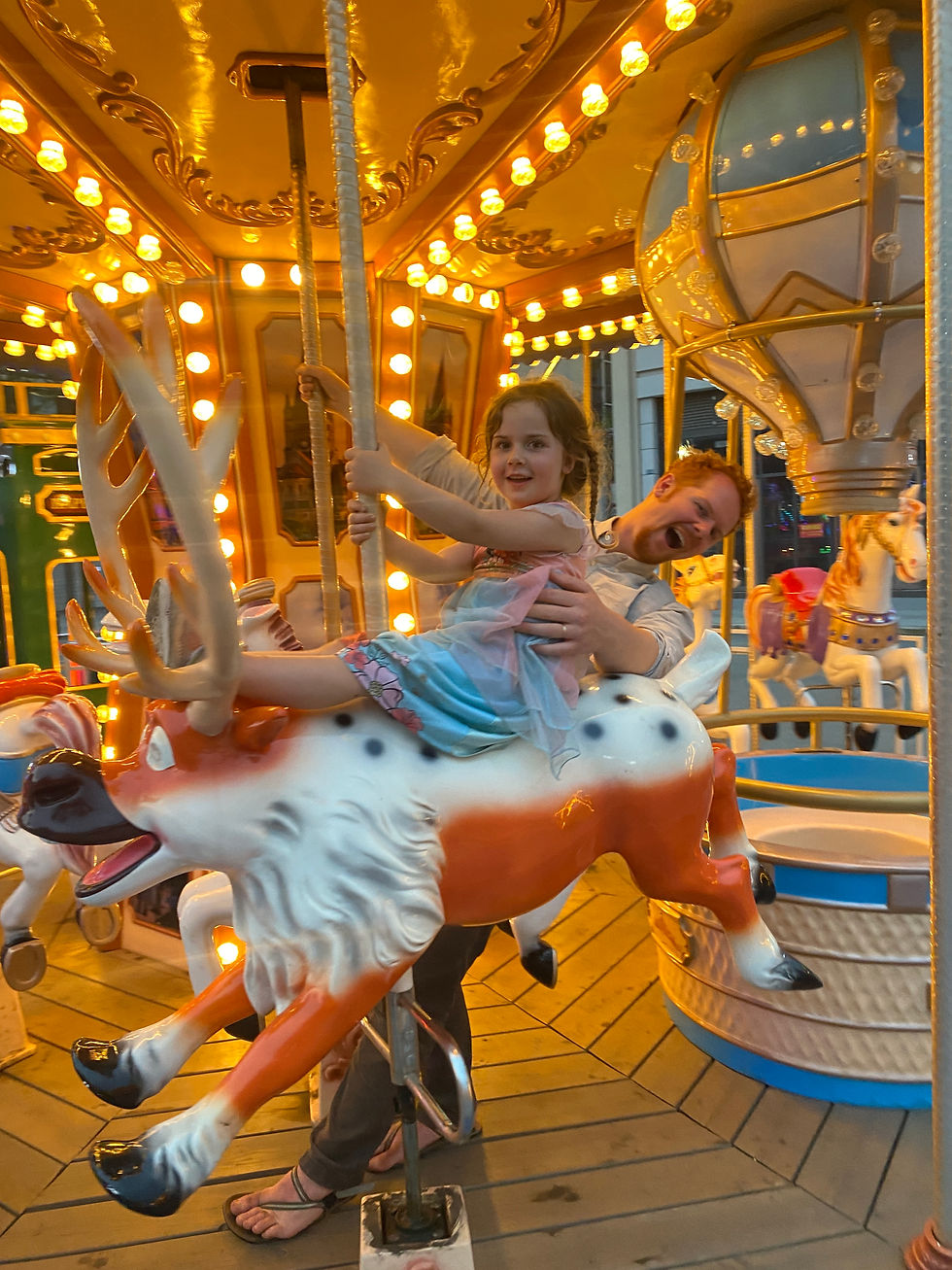
Further into town, the little downtown turned out to be almost a children’s amusement park, a tiny roller coaster, a carousel, a scatter of playgrounds. On our last night we had dinner at a barbecue spot right beside it, the kind of place where the waitress cooks your food for you at the table, and we sat outside so River could go back and forth between climbing with the other kids and coming over for a bite. There was a carousel reindeer that looked exactly like Sven from Frozen, and she was so excited to ride it. Our phones had died, so we could not pay for more tickets, but the people running the rides were so kind, and so happy to have us there, that they let River ride the little roller coaster for free. It was her very first roller coaster, and she was so sweet and excited about it. We walked home through the warm night, and that was our last evening on the mountain.
Mr. Sun’s tea: the heart of Mengding

The real reason for Mengding, though, was the two days we spent going up to an old tea plantation owned by a man named Mr. Sun. He is an artist and something of a Renaissance man, who got deeply interested in tea, in the energetics of it, the nature of it. His work goes hand in hand with that Buddhist monk who came up the mountain to cook for us, the one Liu Li Hong had told us about, who is all about the alchemical transformation of food, turning raw ingredients into true food by purifying them and imparting fire into them. In the same spirit, Mr. Sun talks about tea. Generally the nature of tea is cold, and even though you drink it hot, its energetics are cold, which naturally damages yang. And in Chinese medicine, nourishing life is really about nourishing yang. But remember that yin and yang are inseparable: if you are nourishing yang, you are also building yin, because to hold the yang you must have more yin to hold it with. This, too, is the return to center, the constant tending of the balance that lets the fire warm us instead of burning us up.

What Mr. Sun found was an old tea farm high up on Mengding that had not been cultivated in two hundred years, completely free of pesticides and fertilizers, high enough up to escape any runoff from the farms below. He began farming the old plants there in the most traditional way imaginable, not displacing the existing stones, doing everything he could not to disturb the soil. And he discovered that the tea grown in that place was not cold in nature at all, but actually neutral, which is to say the tea itself had been returned to its center. Drinking it was unlike anything I had had, clean, clear, hydrating, nourishing in a way I do not usually find tea or any caffeinated drink to be. The tea we had with him was absolutely phenomenal. He also spoke to us about teapots, about art and function, about the way a teapot can bring the tea alive. It is a beautiful place, with a beautiful vista out across a valley full of tea farms, something like the Napa Valley of Chinese tea, and it was, in many ways, the true close of the trip.

While we were on Mount Mengding, the same Buddhist monk mentioned by Dr. Liu Lihong drove for three days to come meet us and cook for us, and it was extraordinary. He shared his understanding of what he calls imparting fire into food, both the actual fire of the stove and also the fire of the cook, which means your own heart and mind and intention and love and care poured into every single thing you touch. He boils all of his water first for eight hours to purify and transform it before he ever uses it to cook, and he does this in a clay pot or earthen pot rather than metal, because in the Five Element cycle metal generates more water, and water controls fire. He says you know the ingredients have started their transformation when the aroma erupts, and that is your sign that you are just starting to cook it long enough to really change it into food. He made us noodles from wheat berries he had boiled for thirteen hours before processing and then boiled again to cook. He made a milk tea where the tea itself had steeped and boiled for forty-eight hours. On the surface this sounds unsustainable, almost impossible, and yet what moved both Jack and me so deeply was the same realization hitting us at the same moment: I have never encountered anybody who pours this much love and care and detail and attention into food. To eat something made with that level of intention, to take that love into your own body with each bite, to feel it nourishing not just your flesh but your heart and your spirit, that is what returning to center actually tastes like.
Home, and the long reverberation
After Mr. Sun we made our way back to Chengdu and home on an overnight flight where the girls slept the whole way, grateful to return and already missing it terribly. The trip has kept working on all of us since. Jack now cooks every single one of his meals from scratch, following the principles we learned, and he has boiled water for eight hours more than once, and he has been deeply moved by the whole experience. He has found his own way back to center, meal by meal, in his own kitchen. And I felt the loss of our daily qigong the very first morning I woke up at home without it, the absence of that return immediate and physical. And felt so relieved that my next qi gong classes began the same week we landed. Inspired by this trip, I am for the first time teaching the Fourteen Movements in my Continuing Qi Gong class.
That, in the end, is what I want to hold onto and what I most want to pass on, to my family, my patients, my students, anyone who reads this. Not only the primary water or the carved Buddhas or the tomato cake, wonderful as they all were, but the transmission and the return to center. The reminder that the deepest things move from one lived life into another, in a way no page can fully carry, and that we find our way home not once but over and over, breath by breath and meal by meal and, for me, in every moment I stopped to watch my daughters meet the world with open wonder. I got to stand close to all of that, again and again, in eight different places, alongside the people I love most. I am still letting it work on me.


Comments